
Nigeria may soon witness a major transformation in its financial and export ecosystem as the Senate considers sweeping reforms to strengthen key institutions—including a proposal to increase the NEXIM Bank capital base to ₦1 trillion.
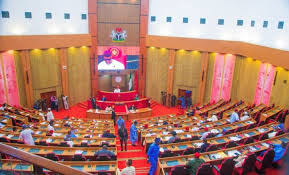
During a public hearing on Wednesday, lawmakers also discussed the creation of an Export Development Trust Fund and a special tribunal dedicated to resolving insurance disputes, signaling a renewed push to modernize Nigeria’s financial regulatory framework.
Two Landmark Bills Set the Stage for Reform
The Senate Committee on Banking, Insurance and Other Financial Institutions hosted the hearing to evaluate two major bills:
- Nigerian Export-Import Bank (Amendment) Bill, 2025
- National Insurance Commission (Repeal) and Insurance Regulatory Commission Bill, 2025
Committee Chairman, Senator Adetokunbo Abiru, explained that the bills aim to modernize outdated laws, reinforce regulatory oversight, and align Nigeria’s financial system with international standards.
“These bills represent a crucial step toward shaping the future of Nigeria’s financial system,”
Abiru said, emphasizing the push for transparency, competitiveness, and innovation-driven regulation.
The proposed NEXIM Amendment Bill updates the bank’s founding 1991 law, while the Insurance Regulatory Commission Bill seeks to replace the obsolete 1997 NAICOM Act.
“A Covenant With Nigeria’s Economic Future” — Senate President
Senate President Godswill Akpabio, represented by Senator Tahir Monguno, described the legislative effort as a defining moment for Nigeria’s economic trajectory.
According to him, empowering NEXIM Bank is essential not just for lending, but for connecting Nigerian industries to global markets. He also noted that the insurance sector must evolve to become a dependable backbone of economic trust and fairness.
Akpabio urged senators to legislate boldly and responsibly:
“History will remember the 10th Senate as one that met the hour with clarity, courage, and conviction.”
Why NEXIM Bank Needs a Bigger Capital Base
NEXIM Bank Managing Director, Abba Bello, stated that the bank’s current capital base of ₦50 billion—about $33 million—is insufficient to support Nigeria’s growing export ambitions, especially under the African Continental Free Trade Area (AfCFTA).
He strongly endorsed the proposed capital increase:
“We support raising the capital base to at least ₦500 billion, and ideally ₦1 trillion, to enable NEXIM to deliver on its mandate.”
Bello also supported reforms to:
- Separate NEXIM’s board leadership from the Central Bank of Nigeria (CBN)
- Ensure continuity of governance
- Establish an Export Development Fund to support export-oriented enterprises
Experts Call for Full ₦1 Trillion Benchmark
The Capital Market Academics of Nigeria argued that anything less than ₦1 trillion would be inadequate, especially when compared with the financial strength of export-import banks in India, China, and South Africa.
They further emphasized that NEXIM’s limited capital has prevented it from securing global credit ratings—an issue that weakens Nigeria’s visibility in international markets.
The group also recommended expanding board membership to include the Chartered Institute of Bankers and the National Association of Chambers of Commerce.
Supporting this, the Ministry of Finance Incorporated (MOFI) reaffirmed that all government equity in NEXIM should be held through MOFI in line with its mandate as the Federal Government’s asset-holding entity.
Boost for Exporters and Insurance Sector
Insurance Commissioner Olusegun Ayo Omosehin described the proposed Export Promotion Trust Fund as a game changer for Nigeria’s non-oil export sector.
“This long-overdue innovation will help exporters access funding for raw materials, logistics, and capital goods.”
The Nigeria Deposit Insurance Corporation (NDIC) also supported the higher capital base and requested inclusion on NEXIM’s board due to its expertise in risk management. NDIC further advocated for stronger accountability measures for the trust fund.
Final Thoughts
If passed, these reforms could significantly reshape Nigeria’s export financing landscape, enhance investor confidence, and strengthen regulatory oversight across banking and insurance sectors. Stakeholders agree on one point:
Nigeria needs stronger institutions to compete globally—and now may be the moment to build them.